The decision you're facing
When a Windows PC refuses to boot, a blank USB stick doesn't help. You need a drive already loaded with recovery tools. That's the gap the Sergei Strelec Ultimate Windows Recovery Tool All-in-One USB tries to fill. It's a pre-flashed USB carrying the latest Sergei Strelec recovery environment.
Quick verdict
If you want a single USB that combines backup, restore, diagnostic tools, and PC unlocking, the $11.99 price makes it an easy choice. The real value is in the preloaded Sergei Strelec environment, not in the physical USB storage.
Who it suits
This is for anyone who wants a ready-made Windows recovery USB without building and configuring a toolkit themselves. It's especially handy if you help friends or family with their PCs and want one drive you can grab when something goes wrong.
What stands out
The main draw is the preloaded Sergei Strelec environment on a single USB. You get unlimited usage, so this isn't a one-time rescue; the same drive can be used again for future recovery jobs. That repeated usefulness is what separates it from a one-off bootable repair image.
Meaningful trade-offs
The physical drive is described as a generic USB, so the value sits in the software, not in a rugged or premium enclosure. This is a recovery-focused toolkit, not a general-purpose flash drive. If you share it with someone unfamiliar with recovery tools, the number of utilities on screen could feel overwhelming at first.
Sergei Strelec ULTIMATE Windows Recovery Tool All-in-One USB (LATEST)
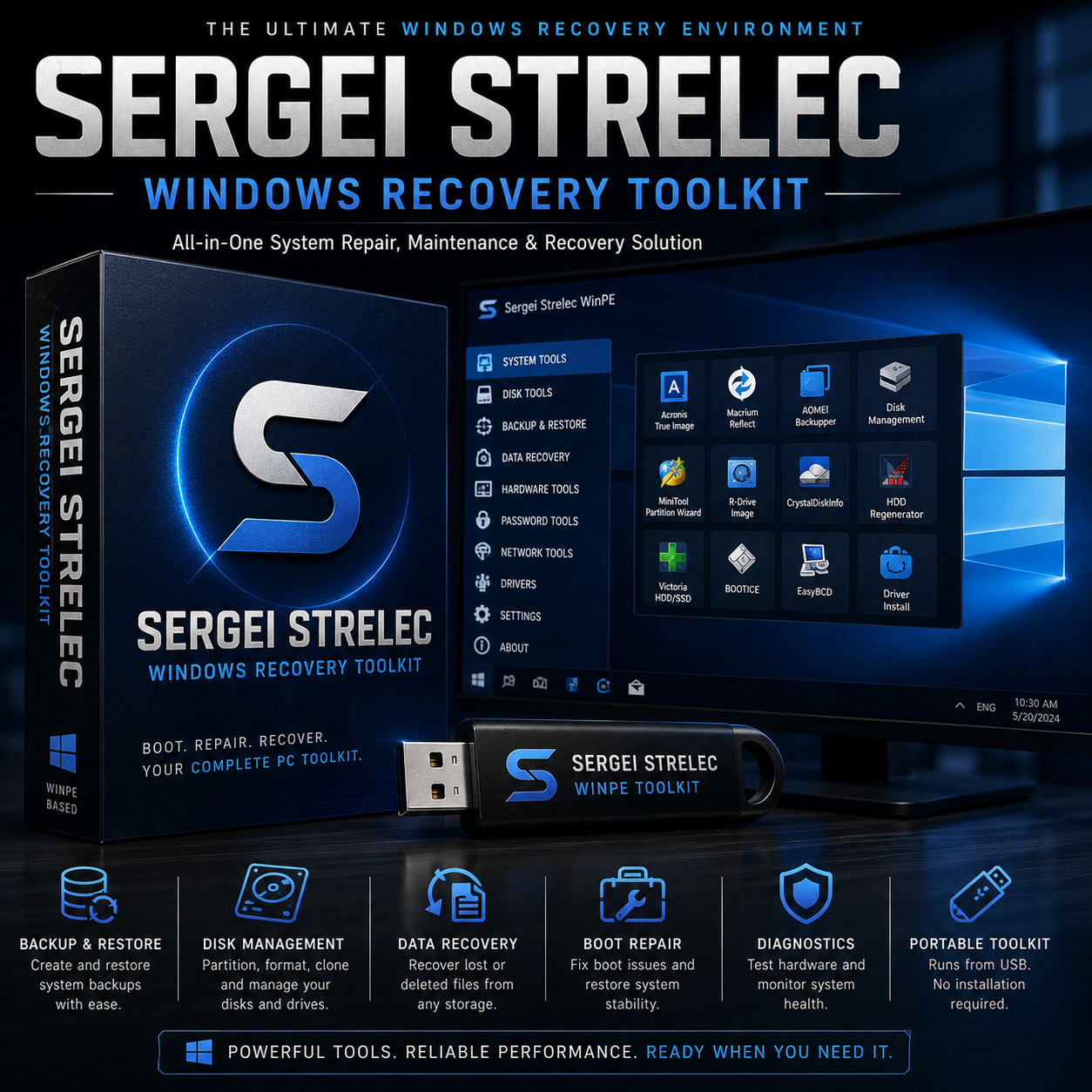
At USD 11.99, this is a generic USB drive flashed with the latest Sergei Strelec recovery environment. The headline features are unlimited usage, backup and restore, diagnostic tools, and PC unlocking. The key trade-off is the physical drive: it's listed as generic USB, so the value is in the software environment rather than the hardware.
Bottom line
The Sergei Strelec All-in-One USB gives you a convenient path to a Windows recovery toolkit. If you don't want to source and configure your own bootable rescue environment, this is a straightforward choice. Just keep in mind that its usefulness depends on the software it carries and that the software is built for recovery scenarios, not everyday file storage.